Create Profitable Podcast Sponsorship Packages That Brands Love
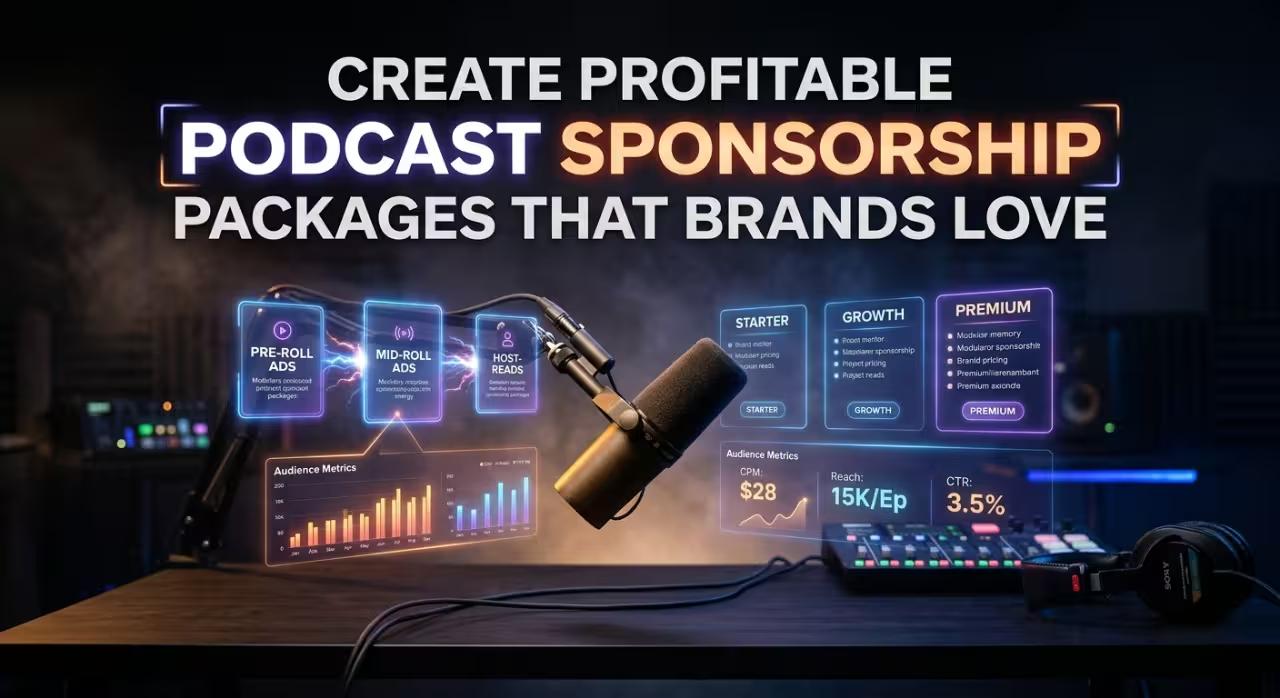
Podcast sponsorship packages are your bread and butter—they're the structured offerings you sell to brands who want a slice of your audience's attention. Think of them as a menu of advertising options, bundling together placements like pre-roll, mid-roll, or host-read ads at prices that reflect your show's reach and your listeners' loyalty.
Building Your Foundation for Sponsorship Success
Before you even dream of sending out a pitch email, you need to get your house in order. Figuring out what you're actually selling is about way more than just flashing big download numbers. To create sponsorship packages that brands can't resist, you have to build a solid foundation based on what makes your show unique, who your audience really is, and what you're trying to achieve financially.
Honestly, without this groundwork, you're just throwing numbers at a wall and hoping something sticks. The podcasters who consistently land great deals aren’t just selling ad slots; they're selling direct access to a dedicated community they've built from the ground up. This means you have to get comfortable with your analytics and learn how to tell a compelling story with them.
Pinpoint Your Podcast's Unique Value
Every single podcast has something that makes it stand out. What’s your secret sauce? Is it your laser-focused niche topic? Your magnetic personality as a host? Maybe it's your top-tier production quality or that buzzing, super-engaged community in your Discord server. Nailing this down is your first real step.
When I was starting out, my download numbers were nothing to write home about. Instead of trying to compete on a metric where I was weak, I flipped the script and focused on my listener retention. I showed potential sponsors that while my audience was small, an incredible 85% of them listened to entire episodes—including the ad reads. That story of loyalty was way more persuasive than a modest download count.
Key Takeaway: Your value isn't just in your audience size, but in your audience's quality and engagement. Find the metric that tells your best story and lead with that.
Analyze the Audience Metrics That Brands Care About
Sponsors are all about ROI. They need to know their message is hitting the right ears. Vague stats just won't cut it; you need to serve up specific, concrete data about your listeners.
Here are the core metrics brands will almost always ask to see:
- Listener Demographics: This is the basic stuff—age, gender, and location. If you can get more detailed info from listener surveys (like income or education levels), even better. This is how a brand confirms your audience is their target customer.
- Downloads per Episode: Be specific here. The industry standard is the average number of downloads an episode gets within its first 30 days. Don't just give a lifetime number.
- Listener Behavior: This is where you can really shine. Go beyond simple downloads and show off metrics like listen-through rates (a huge indicator of engagement) and what platforms your listeners prefer, like Spotify or Apple Podcasts.
- Audience Interests: Think about your content. If you host a podcast on project management, you can confidently say your audience is interested in productivity tools, professional development, and new software. Use your themes to paint a picture of their lives and interests.
Having this data on hand shows you’re a professional who takes this seriously, giving brands the confidence they need to invest. If you're ready to get deeper into the financial side of things, our guide on how to monetize a podcast is a great next step.
Set Clear Monetization Goals
Finally, what’s the end game for you? Your goals will completely shape how you structure your sponsorship packages. Are you just trying to cover your hosting and equipment costs? Or are you aiming to generate a nice side income, or even turn your podcast into a full-time career?
Decide on your financial targets and then work backward. For example, if your goal is to make $1,000 per month, you can quickly figure out how many sponsorship slots you need to sell and at what price. This simple bit of math brings so much clarity to your sales process, from pricing your packages all the way to negotiating contracts. It ensures your sponsorship strategy is actually working for you and your show's long-term vision.
Designing Your Podcast Sponsorship Tiers
Alright, you've nailed down your show's core value. Now it's time to package that value into sponsorship tiers that brands will actually want to buy. This isn't about slapping together a generic template; it's about creating strategic offerings for different budgets and goals.
First, you need to know the basic ad placements. A pre-roll ad is that quick 15-30 second spot right at the top of the show. The mid-roll ad is the prime real estate, usually 60-90 seconds long, placed during a natural content break. And the post-roll ad is a brief mention as you wrap up.
These three principles are the foundation of any solid sponsorship strategy.
Before you build anything, you have to know your audience inside and out, clearly define what makes your show valuable, and set your own monetization goals. Get these right, and the rest falls into place.
The Power of Host-Read Ads
You can technically use pre-recorded ads, but in my experience, host-read ads are where the magic happens. When you, the host, personally endorse a product, it lands as a genuine recommendation, not a jarring commercial break.
Expert Insight: Your listeners show up for you. A host-read ad weaves the sponsor’s message into your show's existing fabric, making it feel native and valuable instead of disruptive. That's what sponsors are paying a premium for.
This trust is fueling the industry's incredible growth. Global ad revenue for podcasts and vodcasts is set to blow past $5 billion by 2026. Host-read ads are projected to command over 62% of that because they simply work—46% of listeners report buying something after hearing a podcast ad. You can dig into the numbers in these podcast statistics for 2026.
Structuring Your Sponsorship Tiers
A tiered structure gives brands an easy way to engage, no matter their budget. I’ve found that a "Starter," "Growth," and "Partner" model works incredibly well. It provides a clear entry point for brands just starting with podcast advertising and a path to scale for those ready for a deeper partnership.
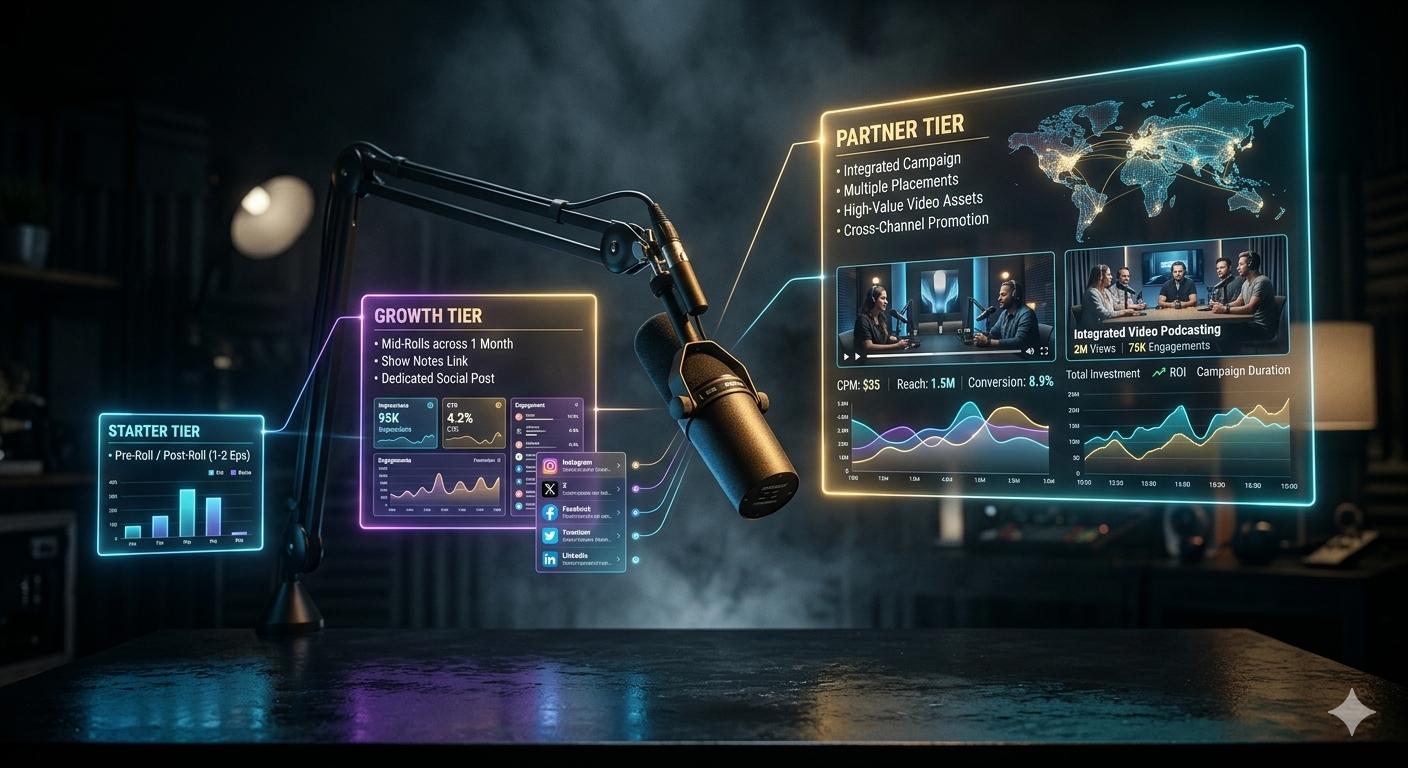
Here’s a simple way to think about it:
- Starter Tier: This is your foot-in-the-door offer. It's perfect for brands testing the waters, usually with a single pre-roll or post-roll mention in one or two episodes.
- Growth Tier: This is the most popular option, offering a solid campaign. You might bundle a mid-roll ad placement across a full month of episodes, plus a link in your show notes and a dedicated social media post.
- Partner Tier: This is your top-shelf, all-in package. Think of it as a true partnership, combining multiple ad placements with high-value video assets and cross-channel promotion for a fully integrated campaign.
Integrating Video Assets for Premium Value
If you're creating a video podcast, you're sitting on a goldmine. Video elements massively increase the value of your packages and justify much higher rates. With 44% of vodcast viewers giving the content their full attention (no multitasking), video ads capture an incredibly focused audience.
Start layering these high-impact video deliverables into your top tiers:
- Branded Lower-Thirds: Flash the sponsor's logo and a tagline on-screen while you're doing the ad read.
- Natural Product Placement: If it makes sense for your show, have the sponsor's product visible in the background or use it organically during an episode.
- Sponsored Segment Overlays: Create a branded graphic that appears during a specific segment, like a "Tip of the Week, brought to you by [Sponsor]."
- Short-Form Social Clips: This is a huge value-add. Edit your sponsored segment into a vertical video (Reel, Short, or TikTok) that the brand can use on its own social channels.
Sample Podcast Sponsorship Package Tiers
Here’s a sample table outlining how you can structure three tiers that combine audio and video deliverables. Use this as a starting point to build out your own packages.
By bundling audio and video assets this way, you’re no longer just selling ad slots. You're offering a comprehensive marketing solution that smart brands will see immediate value in.
How to Price Your Sponsorship Packages
Figuring out what to charge for sponsorships is one of the biggest questions every podcaster faces. You know you’ve built something valuable, but putting a price tag on your content can feel like a shot in the dark. It’s a huge hurdle, but the good news is you don’t have to guess.
There are two primary roads you can take: Cost Per Mille (CPM) and flat-rate pricing. Getting a handle on how each one works, and more importantly, when to use them, is the key to creating a sponsorship strategy that actually pays the bills.
Decoding the CPM Pricing Model
CPM, which stands for Cost Per Mille (that’s Latin for thousand), is the default pricing method in the podcasting industry. At its core, it’s a simple formula: you charge a set dollar amount for every 1,000 downloads an episode gets. Big shows and ad agencies love this model because it’s predictable and scalable, making it easy to measure ad spend against audience reach.
The standard CPM formula is pretty straightforward:
(Total Downloads per Episode / 1,000) x CPM Rate = Ad Price
So, let's say your episodes consistently get 5,000 downloads within the first 30 days. If you use a common industry CPM of $25, the math for a single mid-roll ad spot looks like this:
(5,000 / 1,000) x $25 = $125 per ad
The CPM rate itself isn't a fixed number; it shifts based on where the ad is placed in your episode and whether you're reading it yourself. While rates can always vary, here are some solid industry benchmarks to start with:
- Pre-roll ads (15-30 seconds): $18 - $25 CPM
- Mid-roll ads (60-90 seconds): $25 - $40 CPM
- Post-roll ads (15-30 seconds): $15 - $20 CPM
CPM is the perfect fit for podcasts that have built up a consistent and sizable audience, typically anything over 5,000 downloads per episode. It gives you a data-driven way to justify your rates that experienced advertisers immediately understand and respect.
When Flat-Rate Pricing Makes More Sense
While CPM is the standard, it’s definitely not a one-size-fits-all solution. For newer shows or podcasts serving a super-specific niche, flat-rate pricing is often the smarter move. With this model, you just charge a fixed price—per ad, per episode, or for a whole package—without getting bogged down by exact download counts.
This approach is your best bet when your value is about more than just the size of your audience.
Flat-rate pricing is the way to go if:
- You have a small but mighty audience. Maybe you only have 800 listeners, but they’re all C-suite executives in the B2B tech space. For a brand trying to reach those decision-makers, the value of that hyper-targeted audience is immense. A flat rate of $200 per episode could be an absolute bargain for them, even though a CPM calculation would spit out a much lower number.
- Your download numbers are still finding their rhythm. If your audience is growing but still a bit unpredictable, a flat rate gives both you and your sponsor financial certainty. You lock in a price upfront and avoid any awkward post-campaign calculations.
- You're offering more than just audio. This is especially true for video podcasts. You aren't just selling audio ads; you're selling on-screen branding, product placement, and social media clips. Trying to shoehorn all that value into a simple CPM formula is a recipe for a headache and will almost certainly leave money on the table.
Key Takeaway: Don't sell yourself short just because you don't have massive download numbers. Flat-rate pricing empowers you to set a price based on the quality of your audience and the full scope of your creative work, not just one metric.
Think about it. Say you put together a "Growth Package" that includes one mid-roll ad, a branded lower-third graphic in your video, and a promotional post on your Instagram. Trying to justify that with a CPM rate is messy. Instead, you can confidently price the entire bundle at a flat rate of $750, which clearly reflects the production work and cross-platform exposure you’re delivering. It keeps the sale simple and communicates the true value of the partnership.
By understanding both models, you can pick the one that best reflects your show’s real market value and start building sponsorship packages that are genuinely profitable.
Creating a Media Kit That Actually Sells
Once you've nailed down your sponsorship packages, you need to show them off. That's where your media kit comes in. This isn't just some document—it’s your podcast's resume, portfolio, and sales pitch all rolled into one.
Frankly, it's often the first thing a brand will ever see from you. A sharp, professional kit gets you a reply. A sloppy one gets you ignored. It’s that simple. Think of it as your show's highlight reel, combining cold, hard data with the compelling story of your podcast.
What Every Winning Media Kit Must Include
A great media kit answers all of a sponsor's questions before they even have to ask. It needs to be visually appealing, easy to scan, and stuffed with the information that a marketing manager actually cares about. No fluff. Every single element should scream value.
Here's what you absolutely need to include:
- Podcast Bio and Host Intro: Start with a tight, powerful summary of your show. What’s it about? Who listens? Then, add a quick, professional bio for the host. That personal touch goes a long way in building trust.
- Key Metrics Snapshot: Lead with your biggest numbers. We’re talking average downloads per episode (within 30 days), total monthly downloads, and your social media stats. Make these numbers pop with bold fonts or icons.
- Detailed Audience Demographics: This is where you prove you’re the perfect match. Use simple charts to show age, gender, location, and any other juicy details you have—like education or income level.
- Listener Engagement Data: Downloads are one thing, but engagement is another. Show off your average listen-through rate or your total 5-star reviews. A high listen-through rate is gold—it tells sponsors your audience actually sticks around for the ads.
Presenting Your Sponsorship Packages
Now for the main event. This section of your media kit has one job: to clearly sell your podcast sponsorship packages. A busy brand manager should be able to glance at it and immediately understand what they get at each level.
I recommend using a clean table to lay out your tiers side-by-side—think "Starter," "Growth," and "Partner" packages. Clearly list the deliverables for each, from ad placements to social posts. And always, always include a clear call to action with your contact info.
For those of you with a video podcast, you have an incredible advantage. Visual proof is powerful. If you’re still weighing your options, our guide on podcasts vs. YouTube breaks down the benefits. In your kit, include screenshots of branded segments or link to a sponsored video clip. It makes the value so much more real.
Pro Tip: Don't just email a boring PDF. Use a tool like Canva or Pitch to build a dynamic presentation. Use your show's branding, drop in screenshots of your best social media comments, and embed a link to your most popular episode. Make it an experience, not just a document.
Pitching and Negotiating Sponsorship Deals
Okay, your media kit is polished and your packages are priced. Now for the fun part: turning all that prep work into actual revenue. This is where you start reaching out to brands, making your case, and closing deals.
Forget about blasting generic emails to your dream-brand wish list. That almost never works. The real key is to build a genuine connection and show a brand exactly how a partnership is a win-win, right from the first "hello."
Crafting a Winning Sponsorship Pitch
That first email is everything. Your goal is to be sharp, professional, and completely focused on what the brand gets out of it. Do your homework. A quick search on LinkedIn for a Marketing Manager, Brand Manager, or Content Strategist is your best bet for finding the right contact.
A killer pitch email needs just a few things:
- A strong subject line: Think "Partnership Opportunity with [Your Podcast Name]" or something more specific like "Reaching [Brand's Target Audience] via [Your Podcast Name]."
- A personal touch: Show you're not just spamming them. Mention a recent campaign they launched or a personal reason you admire their product.
- The core value: Get straight to the point. Explain who listens to your show and why they're the perfect audience for the brand. Drop one or two of your best stats from the media kit here.
- A clear call to action: Don't leave them guessing. Suggest a quick call to brainstorm and attach your media kit for them to review.
Expert Tip: Never open by asking for money. Your pitch should be about collaboration and solving a problem for them—giving them access to a dedicated, niche audience. The price talk happens after you’ve proven your value.
Handling Objections and Justifying Your Rates
Once you get a reply and the conversation starts, get ready for some questions. Negotiation is totally normal, so don't be intimidated by a little pushback. The trick is to listen to what they're really asking and respond with confidence, using the data you’ve already put together.
You'll probably run into these common objections:
- How to Respond: Don't jump to a discount. First, walk them through the value one more time. Talk about your audience's engagement, the quality of your listeners, and any extras they get, like video clips or social posts. Help them see the ROI.
- How to Respond: This is the perfect time to offer a trial run. Pitch your "Starter" package for one month to show them what you can do. Let them know you'll track results with a unique promo code, a vanity URL, or a listener survey.
- How to Respond: Turn this into a positive. Try something like, "That's fantastic—it means you already know how powerful podcast advertising is. Our show reaches a unique corner of the [your niche] market that will complement your current campaigns."
Securing the Deal with a Clear Agreement
Once you have a verbal "yes," get it in writing. Always. A simple sponsorship agreement protects you and the brand, making sure there are no surprises later. It doesn't need to be a 50-page legal epic, but it does need to be crystal clear.
Make sure your sponsorship contract nails down these essentials:
- Scope of Work & Deliverables: Get super specific. List the exact number and type of ads (e.g., "four 60-second, host-read mid-roll ads"), the episode release dates, and any other assets you promised.
- Payment Schedule: Spell out the total cost and when you get paid. Is it all upfront, 50% before and 50% after, or net-30?
- Content Approval Process: Define how and when the sponsor gets to approve ad scripts. Set a firm deadline for their feedback so you don't end up chasing them and delaying your production.
- Exclusivity Clause: Clarify if you can feature competing brands. If they want category exclusivity (and they often do), you can and should charge a premium for it.
- Termination Clause: Outline the specific reasons either one of you could end the agreement.
Many brands think about sponsorships much like they would for an event, as this Raptor Technologies event example shows. They want to see clear tiers and know exactly what their investment buys them. A solid contract gets everyone on the same page and sets you up for a great partnership.
Common Questions About Podcast Sponsorships
Even with a solid strategy in place, some questions always seem to pop up when you're ready to explore sponsorships. Getting straight answers on when to start, how to measure results, and the best way to move forward can make all the difference.
Let's cut through the noise and address the common hurdles I see podcasters face when they're building out their first sponsorship packages.
When Is the Right Time to Seek Sponsors
Forget about a magic download number. The real answer is all about engagement.
While industry benchmarks often point to 1,000 downloads per episode as a starting point, I've seen shows with much smaller, hyper-niched audiences land incredible sponsors. A brand will gladly pay a premium to reach 500 of their ideal customers over 5,000 listeners who aren't a good fit. (Source: Buzzsprout, 2023)
If you have a dedicated B2B audience or a community that hangs on your every word, you're ready.
Key Insight: Focus on building a quality show and a loyal community first. When you can prove your audience is engaged and trusts you, you are ready to seek sponsors, regardless of your download count.
How Do I Measure Sponsorship ROI for My Partners
This is how you turn a one-time deal into a recurring partnership. Your job is to connect the dots between their investment and tangible business outcomes. It’s all about providing clear, compelling data.
Here are the essential metrics you need to be tracking and reporting on:
- Download numbers and listen-through rates for the sponsored episodes.
- Click-through rates from your show notes using a custom vanity URL (like
brand.com/yourpodcast). - Redemption rates on any unique promo codes you share.
- Listener surveys to gauge brand recall after the campaign has wrapped.
If you have a video podcast, you can pull in YouTube analytics like view duration and clicks, giving your partners an even fuller picture of the campaign's performance.
Should I Find Sponsors Myself or Join a Podcast Network
Going with a podcast network can seem like a shortcut. They bring advertisers to you, but it comes at a steep price—often a 30-50% cut of your revenue.

When you go independent, you keep 100% of the revenue and maintain total creative control. The trade-off is that you're responsible for all the sales, outreach, and administrative work.
My advice? Start by yourself. It forces you to learn the sales process, understand your show's market value, and build direct relationships with brands. You can always explore a network later once you've established your footing.
What Is the Difference Between a Sponsor and an Affiliate
The two are often confused, but the payment models are completely different.
A sponsorship is a straightforward deal where a brand pays you a flat fee or a CPM rate for a specific number of ad placements. You're paid for giving them access to your audience.
An affiliate partnership, on the other hand, is entirely performance-based. You only earn a commission when someone makes a purchase or signs up through your unique affiliate link or code. Sponsorships give you predictable income, while affiliate marketing offers uncapped earning potential with no guaranteed payout. You can get a much deeper look at this in our guide to affiliate marketing for podcasts.
Ready to create a high-quality video podcast that attracts premium sponsors? The team at micDrop provides end-to-end production, from guided remote recording to multi-cam editing and social media repurposing. We handle the production headaches so you can focus on creating great content. Learn more and book a call with us today.


