Affiliate Marketing for Podcast A Podcaster's Monetization Guide
Affiliate marketing is one of the most organic ways to generate income from your podcast. Done right, it's not about interrupting your show with ads—it’s about earning commissions by recommending products and services you genuinely believe in.
When you partner with brands your audience will love, you create a revenue stream built on trust. For many podcasters, this becomes a reliable source of income that actually enhances the listener's experience.
Building Your Foundation for Affiliate Success
It’s tempting to jump straight into finding partners and sharing discount codes, but a little prep work goes a long way. The most successful affiliate marketing for podcast creators build a strategy that feels like a natural part of their content, not a tacked-on advertisement.
The entire system hinges on listener trust. This is where video podcasts really shine—when your audience can see your authentic excitement for a product, it turns a simple plug into a powerful endorsement. That visual proof builds a much deeper connection than an audio-only mention ever could.
Assess Your Show’s Readiness
Let's be honest: is your podcast truly ready for monetization? Chasing affiliate deals too soon is a classic mistake that can turn off a new and growing audience. Before you even think about reaching out to brands, see how your show stacks up against these benchmarks:
- Consistent Content: Are you publishing on a reliable schedule? Brands want to see that you're committed for the long haul and consistently delivering quality episodes.
- Engaged Audience: Forget vanity metrics. Do you get comments, emails, or DMs about your show? A small, highly engaged audience is infinitely more valuable to a brand than a massive, silent one.
- Clear Niche: Is your show's focus well-defined? It's much easier to find the right partners for a podcast on "financial independence for millennials" (think budgeting apps or investment platforms) than one vaguely about "interesting stuff."
The key to great affiliate marketing is alignment. If your podcast is about sustainable living, promoting a fast-fashion brand will shatter listener trust. But a partnership with an eco-friendly cleaning subscription? That's a genuine value-add.
When you get this right, monetization becomes a helpful resource for your listeners. Your recommendations are seen as curated suggestions that solve a problem or improve their lives. You can explore more strategies in our guide on how to monetize a podcast.
Focus on Metrics That Matter to Brands
You might be focused on your download count, but brands are digging deeper. They need to see proof that your audience doesn't just listen—they take action.
Here are the metrics that will actually get a potential partner's attention:
- Audience Demographics: Knowing the general age, location, and interests of your listeners is crucial. This helps brands confirm your audience is their target market.
- Listener Engagement: Don't just say your audience is engaged; prove it. Share screenshots of positive comments or mention the high open rates on your email newsletter. This shows you have a loyal community.
- Website & Social Traffic: If your podcast is already driving listeners to your website or social media channels, that’s a powerful signal of your influence.
Finally, set realistic goals. Your affiliate income will probably start small. Instead of aiming for a $1,000 payout in your first month, focus on getting the system working. Think of it like a snowball: it starts small but builds momentum over time. Your first goal is simply to prove that your audience trusts you enough to click and convert. That initial proof is what sets the stage for bigger and better partnerships down the road.
How to Find and Secure the Right Affiliate Partners
Alright, you've got a solid podcast and an engaged audience. Now, it's time to monetize that trust by finding brands that are a perfect match for your show and your listeners.
This is the most critical part of affiliate marketing for any podcast creator. Get it right, and your recommendations feel like a valuable service. Get it wrong, and it’s just a jarring, trust-breaking ad.
This isn’t about grabbing any company with an open affiliate program. It's about being strategic. The goal is to find products you can genuinely get behind—things that solve a real problem for your listeners.
Affiliate Networks vs. Direct Partnerships
First, you need to decide how you'll find these partners. There are two main roads you can take: joining big affiliate networks or reaching out to brands directly. Each has its place, and the right choice often depends on where you are in your podcasting journey.
Affiliate Networks are essentially marketplaces connecting you with thousands of brands. Think of platforms like Awin, ShareASale, or Rakuten.
- Pros: They offer a massive menu of programs to choose from, plus they handle all the payment processing and link tracking. For newer podcasts, it’s a great way to jump in and start earning without a ton of back-and-forth.
- Cons: The commission rates can be lower, and it's tough to build a real relationship with the brand. You're just one of many affiliates in their system.
Direct Partnerships mean you're cutting out the middleman and creating a custom deal directly with a brand.
- Pros: This is where you can negotiate higher commission rates and get cool perks like custom landing pages or exclusive vanity codes (think "PODCAST20"). You build an actual relationship, which can lead to bigger and better collaborations down the road.
- Cons: It’s more work upfront. You have to hunt down the right contacts, craft a compelling pitch, and negotiate all the terms yourself. This path is usually a better fit once you have an established audience to show off.
For most podcasters, a hybrid approach is the way to go. Start on the networks to get your feet wet and prove you can drive results. Once you have some data and momentum, you can start reaching out to your dream brands for direct deals.
Finding Partners That Just Make Sense
Think about what you and your listeners are always talking about. What problems are they trying to solve? What are their biggest goals? The answers are your roadmap to the perfect partners.
If you host a B2B tech podcast, your audience is probably full of founders and marketers. Promoting project management tools, CRM software, or marketing automation platforms is a no-brainer. But if your show is all about wellness, partnerships with meditation apps, organic food brands, or fitness gear would feel much more natural.
The most powerful affiliate promotions come from genuine enthusiasm. Look for products you already use and love. When you're a true fan, your recommendation doesn't sound like an ad—it sounds like a great tip from a trusted friend.
Brands are actively looking for partners like you. Affiliate marketing is booming, with 71% of advertisers ranking it nearly as effective as paid search (Source: Awin). And with an average ROI of $13 for every dollar spent (Source: Awin), they're eager to find creators who can deliver. This is especially true for video podcasters, who operate in a space where creator collaborations are the norm.
You can hear more about where the industry is headed in this Awin podcast episode on affiliate marketing predictions.
How to Pitch a Brand and Negotiate a Win-Win Deal
When you’re ready to go direct, a well-crafted outreach email is your best friend. Forget the generic, copy-paste messages. A little personalization goes a long way and shows you've actually done your homework.
Here’s a simple structure that I’ve seen work time and time again:
- A Clear Subject Line: Get straight to the point. "Partnership Inquiry: [Your Podcast Name] x [Brand Name]".
- A Personal Intro: Start by telling them why you love their product and why it's a perfect fit for your audience.
- Show Off Your Show: Share your key stats—monthly downloads, listener demographics, and any engagement numbers you’re proud of. Don't forget to link to your best episode.
- State Your Intent: Clearly say you're interested in forming an affiliate partnership.
- Make the Ask: Don't be afraid to negotiate. If you know you can drive sales, ask for a commission rate that's higher than what they offer publicly. This is also the time to ask for a unique vanity code for your audience.
This kind of professional, data-backed approach instantly signals that you’re a serious partner, not just another creator with their hand out. It lays the groundwork for a strong, long-term relationship where everyone wins.
Integrating Promotions That Your Audience Will Love
Finding the right affiliate partner is a huge win, but it's only the beginning. How you present that product to your listeners is everything. The goal isn't to shoehorn in an ad; it's to offer a genuine recommendation that feels like a natural part of your show.
Your most valuable currency in affiliate marketing for podcasting is trust. When you genuinely use and believe in a product, that excitement comes through in your delivery. This is what turns a simple plug into a powerful endorsement that actually gets your audience to listen—and act.
The Art of the Host-Read Ad
The host-read ad is the undisputed king of podcast promotions. It works because it’s personal. You’re not playing a generic, pre-recorded spot; you’re leveraging the unique relationship you’ve spent countless hours building with your listeners.
The secret to a great host-read ad is storytelling. Don’t just rattle off a list of features. Instead, talk about how the product solved a real problem for you. Promoting a project management tool? Describe the chaos of a specific project before you started using it and how the software brought clarity and order. That kind of narrative sticks with people far better than a dry feature list.
Pro-Tip: Ditch the full script. Ask the brand for a list of key talking points and then deliver the message in your own voice. Your authentic language and personal stories are what make the promotion work.
Choosing the Right Ad Placement
The timing of your promotion can make or break its success. Every ad slot has its own strengths, and the best one for you will depend on your show’s format and the specific offer.
To help you decide, here’s a quick rundown of where to place your affiliate spots.
Podcast Affiliate Ad Placement Comparison
This table breaks down the three main ad placements in a podcast episode, highlighting the pros, cons, and best use cases for each.
Understanding your audience's listening habits is key here. Dive into your podcast analytics to see where listener drop-off happens. If a huge chunk of your audience leaves before the last five minutes, a post-roll ad is probably a waste of time. Use that data to place your most important promotions where they'll have the biggest impact.
Crafting Compelling Scripts and Visuals
A great ad script should feel like a natural extension of your content. A simple but effective formula is to hook the listener with a relatable problem, then introduce the product as the perfect solution.
If you produce a video podcast, you have even more tools to make your promotions stand out.
- On-Screen Graphics: When you mention a discount code, pop it up on screen as a lower-third graphic. Visuals make it much easier for your audience to remember and use.
- Clickable Links: Take full advantage of YouTube's features. Add your tracked affiliate link into an on-screen card and make sure it’s the very first link in your video description for easy clicks.
- Product Demos: For video podcasts, showing is always more powerful than telling. A quick screen share of you using a software tool or an unboxing of a physical product is incredibly persuasive. You could even build entire episodes around interesting podcast topics where visual demos are a perfect fit.
The infographic below outlines the simple, three-step journey to finding and securing these valuable partnerships.

This process moves from broad identification to direct negotiation, helping you forge strong and effective affiliate relationships.
Podcasters are quickly becoming go-to partners for brands, and the data shows why. Podcast ads boast an incredible 71% brand recall rate—more than double that of TV ads (Source: Nielsen). With affiliate marketing now accounting for 16% of all e-commerce sales in North America (Source: Mediakix), it's no wonder that 57% of marketers are increasing their affiliate budgets (Source: Awin). By integrating promotions thoughtfully, you're not just selling—you're providing curated solutions that add real value to your content.
Tracking and Optimizing Your Affiliate Performance
Getting your first affiliate promotions live is a huge milestone. But the real work—and where the real money is made—comes next. If you aren't measuring what's working, you can't improve it. This is where we get into the nuts and bolts of affiliate marketing for podcast creators.
The classic attribution problem has always been a thorn in the side of podcasters. A listener hears your recommendation on their commute, gets to the office, and just Googles the product. Poof. Your affiliate link is bypassed, and you lose the credit. Thankfully, there are straightforward ways to track your influence and make sure you get paid for the sales you generate.
Mastering Your Tracking Tools
The entire game of affiliate tracking boils down to giving your audience an incredibly easy and memorable way to take action. Forget about reading out long, complex URLs that no one can remember from an audio-only format.
Your two best friends here are vanity codes and trackable short links.
Vanity Promo Codes are your secret weapon. These are custom discount codes unique to your show, like "MICDROP20." They are your most reliable attribution tool for a few key reasons:
- Easy to Remember: A simple code is a breeze for listeners to recall and type in later.
- Direct Attribution: Every single time that code is used, the sale is credited directly to you. It doesn't matter how the customer got to the website.
- Perceived Value: An exclusive code makes your audience feel like they're getting a special insider deal just for being a loyal listener.
Trackable Short Links are the other half of the equation. Using services like Bitly or a WordPress plugin like Pretty Links lets you create clean URLs (e.g., yourshow.com/deal). These are perfect for your show notes, video descriptions, and social media posts where people can actually click.
Don't make your listeners do the heavy lifting. A vanity code is perfect for your on-air mentions, while a short link is ideal for show notes. Use both together to cover all your bases and maximize your odds of getting credit.
Decoding Your Affiliate Dashboard
Once your codes and links are out in the wild, your affiliate dashboard becomes mission control. This is where you’ll find all the data to see what’s hitting the mark and what’s falling flat. Don't get overwhelmed by the numbers; just focus on these key metrics to start.
- Clicks: Shows how many people were interested enough to click your link. If clicks are low, your call-to-action might need more punch or your link isn't placed prominently enough.
- Conversions (Sales): The holy grail. This is how many people actually made a purchase and proves your ROI to the brand.
- Conversion Rate: The percentage of clicks that turn into a sale. This tells you how persuasive your recommendation truly is.
- Earnings Per Click (EPC): This metric shows how much you earn, on average, for every single click. It's fantastic for quickly identifying your most profitable promotions.
When you start analyzing this data, you'll spot trends. Is one product crushing it? Maybe that type of offer resonates best with your audience. Are clicks high but conversions are low? That could signal a problem with the partner's landing page or pricing—incredibly valuable feedback you can bring back to them.
The Power of Video in Affiliate Marketing
If you have a video podcast, you have a massive advantage in tracking and converting. While audio-only shows rely on listener recall, video lets you prompt direct, immediate action through on-screen visuals and clickable elements.
This is a complete game-changer for affiliate success. Research shows that 90% of marketers see increased brand awareness through video, 86% report a boost in traffic, and 82% enjoy longer user sessions on their sites (Source: Wyzowl). These are all critical ingredients for driving affiliate sales.
While average affiliate conversion rates are often between 0.5-1%, the return can be enormous. We’ve seen podcasters hit a staggering $149.76 RPM (Revenue Per Mille) per 1,000 visitors. You can learn more about these affiliate marketing statistics to see the full picture. The combination of podcast-style trust and video's interactive power is a truly potent mix.
When you optimize your strategy with data, you can have far more productive, evidence-based conversations with your partners. Show them exactly how many clicks and sales you're driving, and you instantly transform from "just another creator" to a valued performance partner. This is how you negotiate higher commissions and build stronger, more profitable relationships for the long haul.
How to Scale Your Affiliate Content Beyond Episodes
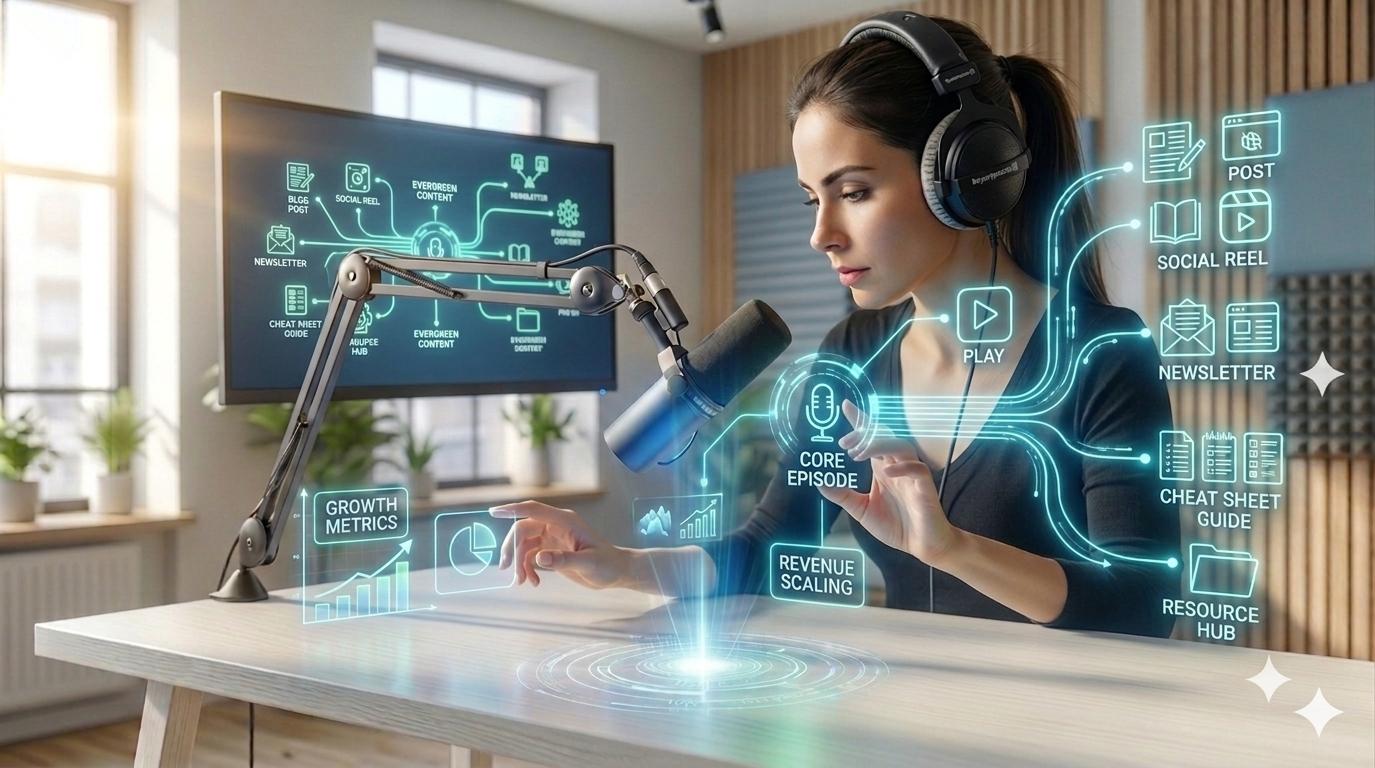
Your affiliate promotions have a much longer shelf life than a single episode. To get the most out of your affiliate marketing for podcast efforts, you need to think beyond the initial publish date and give your best content a second life.
The most successful podcasters treat their episodes as a core asset, but not the only one. They build an entire marketing ecosystem around their content, ensuring that a great host-read ad doesn't just fade into the back catalog. By repurposing your key affiliate segments, you create an evergreen engine that drives revenue long after an episode airs.
Build a Central Hub for Your Recommendations
One of the simplest yet most powerful tactics is creating a dedicated 'Resources' or 'Deals' page on your website. This page becomes the single, go-to source for every product, tool, or service you endorse.
Think about it from your listener's perspective. Instead of trying to remember a specific discount code or scrubbing through old episodes, they have one convenient destination. This ease of access dramatically boosts the chances they'll use your affiliate link.
Make this page a standard part of your show's outro. A simple, consistent call-to-action like, "You can find all of our favorite tools and exclusive discounts on our website at yourshow.com/resources," will drive high-intent traffic directly to your highest-converting links.
Repurpose Your Best Segments for Social Media
Your most authentic affiliate reads are social media gold. By extracting short, high-impact clips from your episodes, you can reach a much broader audience on platforms where they’re already scrolling and discovering new products.
Here are a few practical ways to do this:
- Short-Form Video Clips: Grab the 30-60 second part where you share a personal story about a product and turn it into a TikTok or Instagram Reel. Just add captions and a clear graphic with your promo code.
- Audiograms: For those powerful audio-only moments, an audiogram works wonders. It’s just a static image with an animated waveform and captions, perfect for sharing on LinkedIn or in Instagram Stories.
- Quote Graphics: Pull a standout line from your affiliate mention and create a clean, shareable graphic. These perform well on Pinterest and LinkedIn, driving traffic back to your resources page or the full episode.
Think of your full episode as the 'pillar.' From that single pillar, you can carve out dozens of smaller 'micro-content' pieces. This strategy multiplies your output without you having to constantly create new material from scratch.
Activate Your Email List for Targeted Promos
Your email list is your direct connection to your most dedicated fans. These are the people who have explicitly asked to hear from you, which makes them the perfect audience for your affiliate offers.
But don't just send out a blast of sales pitches. The key is to weave your recommendations into your newsletter content in a way that feels genuinely helpful.
For instance, you could send a weekly email sharing a key takeaway from your latest episode. Within that email, you can naturally mention a tool that helped you, complete with your affiliate link and discount code. It comes across as a useful tip, not a hard sell, which preserves the trust you've built with your subscribers.
By tying together a dedicated website page, social media repurposing, and strategic email marketing, you create a powerful system that extends the life and value of your affiliate content.
Understanding how to adapt your content for different platforms is also key. You can explore the strategic differences between audio and video by checking out our comparison of podcasts vs YouTube. This ecosystem approach is how you turn one-off promotions into a steady, reliable income stream that grows right alongside your show.
Common Questions About Podcast Affiliate Marketing
Jumping into affiliate marketing always brings up a few key questions. It’s a smart way to monetize, but it's natural to have some uncertainty when you're just getting started. I've heard them all, so let’s clear up the most common hurdles you might be thinking about.
How Big Does My Audience Need to Be?
This is always the first question, and the answer is simpler than you think: you don't need a massive audience, but you do need an engaged one.
Many podcasters get hung up on needing tens of thousands of downloads before they even think about affiliates. The reality? Brands care far more about the quality and trust of your audience than its raw size.
A brand would much rather partner with a show that has 1,000 die-hard fans hanging on every word than one with 10,000 passive listeners who aren’t really paying attention.
Focus on building a community first. Once you have a dedicated group of listeners who trust your recommendations and engage with your content, even a smaller audience becomes incredibly valuable for partnerships.
How Do I Disclose Affiliate Relationships?
Transparency is everything. This isn't just about following the rules (which you absolutely must do, per FTC guidelines), it's about keeping the trust you've worked so hard to build.
Good news: your disclosure doesn't need to be some clunky, legal-sounding statement. Just be upfront and weave it into your script naturally.
Here’s a simple, conversational way to do it:
- "This episode is supported by [Brand]. If you check them out using our code PODCAST20, you'll get a great discount, and we'll get a small commission. It’s an awesome way to support the show at no extra cost to you!"
Your listeners will appreciate the honesty. Being clear and direct only strengthens that connection.
What Kind of Commission Rates Should I Expect?
Commission rates can feel all over the place, but they usually follow a pretty standard pattern depending on what you're promoting. Knowing the benchmarks helps you spot a good deal and negotiate with confidence.
Here’s a quick breakdown:
- Physical Products: These have real-world costs, so margins are tighter. Expect commissions in the 3% to 10% range for things like books, consumer goods, or electronics.
- Digital Products & Software: With almost no overhead, these partners can be much more generous. Rates of 20% to 50% are pretty standard for courses, SaaS tools, and digital downloads.
Once you have data proving you can drive sales, don't be shy about negotiating. As your influence grows, you gain leverage. You can push for a higher rate or even a hybrid deal with a flat fee. It all comes down to showing your worth.
Ready to stop worrying about production and start creating a high-quality video podcast that brands love? At micDrop, we handle everything from remote recording and professional editing to repurposing your best moments for social media. Let's build your show together.


