How to Start a Podcast with No Audience From Scratch
Starting a podcast when you have zero audience feels like you're about to shout into a void. It's the number one fear I hear from new creators.
But here’s the secret: almost every show you love, from niche hits to the ones topping the charts, started with zero listeners. The difference-maker isn't a pre-existing follower count; it’s a magnetic, well-defined concept that pulls the right people in.
Forget chasing a huge, undefined audience. Your first goal is to build a minimum viable audience—a small but mighty group of listeners who are genuinely hooked on your topic. This is about depth over breadth. You're creating something truly meaningful for a select few who will become your first evangelists.
Your Blueprint for Launching a Podcast Without an Audience
The key is to create a show so specific and valuable that it becomes a magnet for the right people. This approach flips the script from finding an audience to building one from the ground up, one loyal listener at a time.
Validate Your Idea Before You Hit Record
Before you even think about buying a microphone, you absolutely must validate your podcast idea. You need proof that other people are actively looking for what you plan to talk about.
When I was launching my first show, I spent weeks lurking in specific Reddit forums and industry Slack channels. My goal wasn't to promote, just to listen. I was hunting for:
- Recurring questions: What problems were people trying to solve again and again?
- Passionate discussions: Which topics ignited strong opinions and deep engagement?
- Content gaps: What information were they missing? What solution or resource were they wishing existed?
This "e-listening" tour proved my concept had legs before I invested a single dollar or minute into recording. Your actionable step is to identify 3-5 online communities where your ideal listener hangs out and spend one week just reading and observing. Note down every recurring question or complaint you see. This is your future content goldmine.
The Growing Opportunity for New Shows
The good news? You're stepping into a booming industry. Global podcast advertising revenue is expected to reach nearly $4 billion in 2024 (Source: Statista), signaling a massive commercial and creative opportunity.
This explosive growth means listener habits are already baked in. People are actively searching for new content, and they're dedicated. Weekly listeners spend an average of 6.3 hours tuned into podcasts, proving this is a medium built on deep engagement, not just fly-by clicks. You can find more data on these podcasting trends on Content Allies.
The most powerful asset you have when starting with no audience is a crystal-clear, hyper-specific podcast concept. It’s what turns a potential listener into a loyal subscriber.
This foundation is everything. By focusing on a niche you can genuinely serve, you’re not just creating another podcast. You're building a valuable resource that a specific community has been waiting for. This is how you build a show that lasts.
Finding Your Niche and Unique Angle for Growth
When you're launching a podcast to an audience of zero, your concept is everything. A sharp, defensible niche isn't just a nice-to-have; it's your only real competitive advantage. Forget vague advice like "follow your passion." Let's get practical and find a topic you can truly own.
At first glance, the podcasting world looks incredibly crowded. But the data reveals a different story. While the global index lists around 4.52 million podcasts, the real insight is that only about 15% of them are actively publishing.
That means a staggering 85% of indexed shows haven't dropped an episode in the last 90 days. They're what we call "podfaded." For you, this means the field of active, consistent creators is much smaller than it appears, leaving a massive opportunity for new shows to break through. You can learn more about these podcast statistics and what they mean for creators.
This is the perfect environment for a niche-down strategy. Instead of a general 'marketing' podcast, laser-focus on something like 'growth marketing for D2C subscription box startups.' This ultra-specific approach immediately answers the most important question for any potential listener: "Is this for me?"
Define Your Ideal Listener Avatar
To build a show that actually connects, you have to know exactly who you're talking to. Don't just picture a demographic; create a detailed ideal listener avatar. This is a semi-fictional profile of the one person your podcast is built for.
Get specific enough to answer these questions about them:
- What are their biggest career frustrations and pain points right now?
- What are their professional goals for the next 12 months?
- Which online communities (like Reddit, Slack, or niche forums) do they actually trust for advice?
- What other podcasts or newsletters are already in their rotation?
Actionable insight: Write a one-page document for your avatar. Give them a name, job title, and a quote that summarizes their primary struggle. Before you plan any episode, ask yourself: "Would [Avatar's Name] find this valuable enough to stop what they're doing and listen?"
Your goal is to create a podcast so relevant to a small, specific group that they can't help but talk about it. These initial superfans will become your most powerful marketing engine.
Find Your Unique Content Tilt
Once you have your niche and your avatar, it’s time to find your content tilt. This is the unique perspective or angle that only you can bring to the table. It's what makes your show different from every other one in the same category.
Your tilt can come from a few places:
- Your Personal Experience: Have you solved the exact problem your listeners are currently facing?
- A Contrarian Viewpoint: Do you completely disagree with the common wisdom in your industry?
- A Unique Format: Could you focus only on case studies, 10-minute tactical tips, or deep-dive interviews?
For example, a show about interesting podcast topics could be generic. But a show that specifically analyzes why certain topics fail and provides a data-backed framework for validation? That has a strong, memorable tilt.
By combining a hyper-specific niche, a deeply understood listener, and a distinct content tilt, you create an undeniable value proposition. This is how you start with no audience and build a dedicated following from the ground up. You’re not just making noise; you're creating a signal the right people have been waiting to hear.
Choosing the Right Tech for a Professional Sound
When you're trying to build an audience from scratch, your audio and video quality are non-negotiable. Listeners have endless choices, and amateur sound is one of the fastest ways to lose a potential subscriber.
But getting a professional sound doesn’t mean you need a Hollywood budget. It’s all about creating a smart, repeatable system.
Your main goal should be a workflow that lets you focus on the conversation, not on fighting with your technology. This means picking the right gear for your budget and mastering a simple recording process that makes both you and your guests sound incredible every single time.
Tiered Gear Recommendations for New Podcasters
It’s easy to get lost in gear reviews. To cut through the noise, here are some tiered recommendations that focus on value and ease of use. You don't need the "best" gear to start—just the right gear for where you are right now.
Good Starting Point (Under $150)
- Microphone: Audio-Technica AT2020 (XLR) or Rode NT-USB+. These mics deliver incredible clarity for their price. The XLR version gives you a better upgrade path, but the USB model is pure plug-and-play simplicity.
- Camera: Your smartphone. Seriously. Modern phone cameras are more than capable of producing high-quality 1080p or 4K video, especially if you have good lighting.
Better Setup (Investing in Quality)
- Microphone: Shure MV7. This hybrid USB/XLR mic is a podcaster favorite for a reason. It gives you rich, broadcast-quality audio with fantastic background noise rejection, and its flexibility lets you upgrade your setup down the road.
- Camera: Logitech Brio 4K or a mirrorless camera like the Sony ZV-E10. A dedicated webcam or an entry-level mirrorless offers a huge leap in video quality, with better low-light performance and more control.
Best Long-Term Investment (Pro-Level Sound)
- Microphone: Shure SM7B. This is the industry-standard mic you see in all the top studios. It requires an audio interface to power it, but the warm, professional vocal tone is simply unmatched.
- Camera: Sony a6400 or a similar mid-range mirrorless. This level of camera gives you cinematic quality, interchangeable lenses, and superior autofocus that makes your video look incredibly polished.
If you’re starting with an XLR microphone like the AT2020 or the Shure SM7B, you'll need an audio interface to connect it to your computer. For a deeper dive, check out our guide on choosing an audio interface for podcasting.
The DIY Editor vs. The Production Studio
Once you’ve got your raw recordings, you hit a fork in the road: edit it yourself or outsource it?
Editing is so much more than just cutting out "ums" and "ahs." It’s mixing audio levels, removing background noise, adding your intro/outro music, and mastering the final file. A DIY approach with software like Descript or Audacity gives you total creative control and saves money upfront.
The catch? The learning curve is steep, and the time commitment is huge—often 3-4 hours of editing for every one hour of audio you record.
The real cost of DIY editing isn't the software; it's the time you could have spent creating more content, booking guests, or promoting your show. Consistency is the most important factor for growth, and if editing becomes a bottleneck, your publishing schedule will suffer.
Outsourcing to a production studio like micDrop turns editing into an investment in your consistency and quality. You just hand off the raw files and get back a polished, publish-ready episode. This frees you up to stay in your "zone of genius"—being the host. It requires a financial investment, but it builds a sustainable system for the long haul, which is key when you're trying to start a podcast with no audience.
A Repeatable Remote Recording Workflow
The biggest audio headache for new podcasters isn't their own mic—it's their guest's. You can have a top-tier Shure SM7B, but if your guest is using their laptop’s crackly built-in mic, the entire episode’s quality takes a nosedive.
Here’s a simple, non-negotiable process for every remote recording:
- Use a Double-Ender Recording Tool: Platforms like Riverside.fm, Zencastr, or SquadCast are game-changers. They record each person's audio and video locally, so you get a pristine, high-quality file from your guest that isn't ruined by internet glitches or lag.
- Guide Your Guest's Setup: Five minutes before you hit record, walk your guest through a quick audio check. Ask them to wear headphones (even basic earbuds work) to kill any echo. Help them find a quiet room with soft surfaces—like a bedroom or even a closet—to cut down on reverb.
- Do a Sound Check: Record a 30-second test clip. Listen back with your headphones. This is your chance to catch any background hum, peaking audio, or other distracting noises before you dive into the full interview.
This simple pre-flight checklist takes less than five minutes but makes a world of difference. It ensures every single episode meets a baseline quality standard, helping you earn the trust of new listeners one professional-sounding episode at a time.
Crafting Your Launch and First Episodes Strategy
Dropping a single, lonely episode into the void is one of the biggest missteps you can make when launching a podcast. If you're starting from scratch with zero audience, you need a content buffer to get new listeners hooked and signal to platforms like Spotify and Apple Podcasts that your show is the real deal.
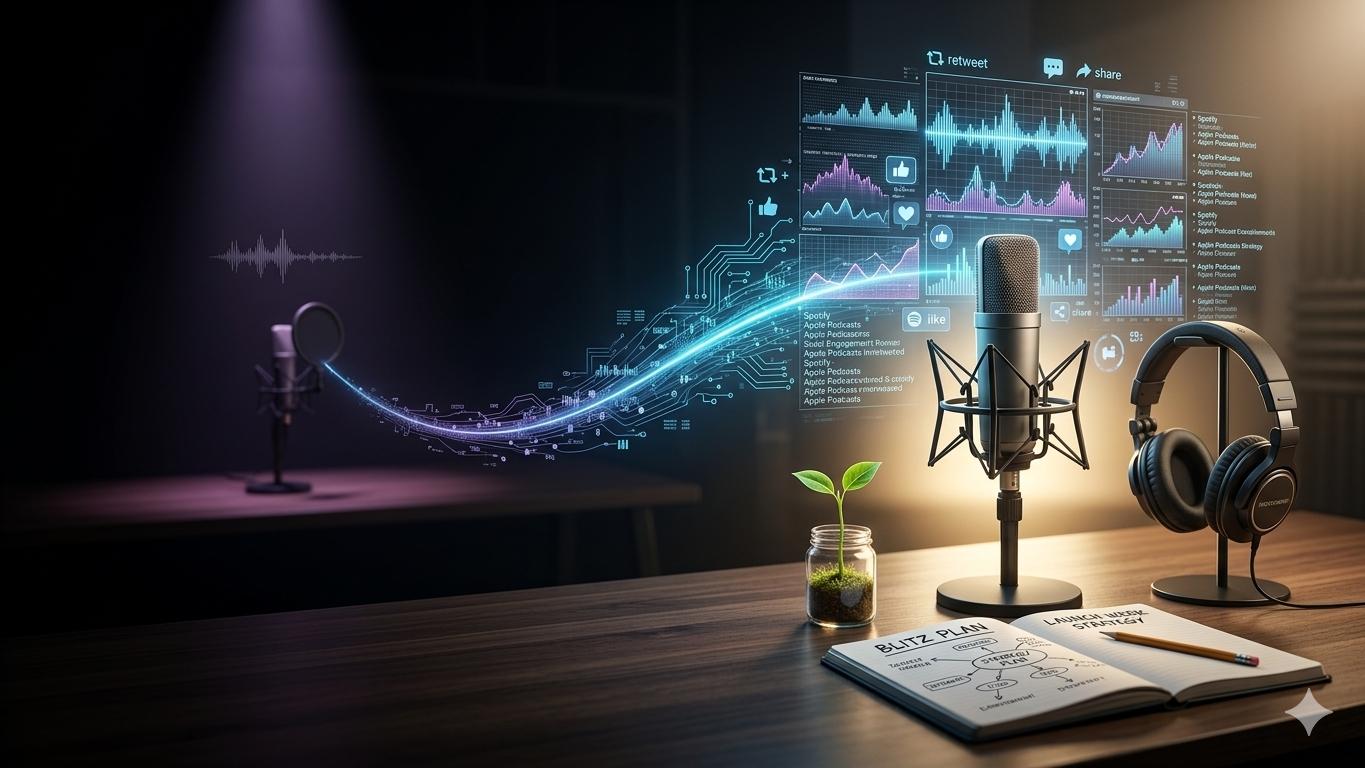
A weak launch kills your momentum before you even have a chance to build any. Instead, we're going to plan a "Launch Week Blitz"—a coordinated push designed to make a splash by borrowing the audiences of others.
The Power of Batching Your First Episodes
Before you even think about publishing, your first objective is to build a small backlog of episodes. I always tell new podcasters to batch-record their first 3 to 5 episodes before launch day.
This does two crucial things for you right out of the gate. First, it gives new listeners a binge-worthy catalog. When someone discovers your show and loves the first episode, they can immediately jump into two or three more. That deepens their connection and makes them far more likely to subscribe.
Second, it’s a huge stress-reducer. Having a few episodes "in the can" creates a valuable buffer, saving you from the weekly scramble to record and edit. This frees you up to focus on promotion during those critical first few weeks.
This simple workflow is the core of your production process.
Mastering this record-edit-distribute cycle is the fundamental skill of podcasting, and batching helps you build that muscle from day one.
Submitting to Directories and Preparing for Launch
Once you have those first few episodes ready and uploaded to your podcast host, you’ll get your RSS feed. This is the unique link that tells podcast directories where to find your show and pull new episodes.
You need to submit this RSS feed to all the major platforms at least two weeks before your official launch date. Don't skip this. Approval times can vary wildly, and the last thing you want is a technical delay torpedoing your big push.
Get your show submitted to these key directories:
- Apple Podcasts
- Spotify
- Google Podcasts
- Amazon Music / Audible
- Samsung Podcasts
- Pocket Casts
Ticking this box early ensures your podcast is live and searchable everywhere the moment you start your promotion.
Your Step-by-Step Promotional Checklist
To keep things organized, use a simple checklist for your launch week. This helps you map out your promotional activities and ensures nothing falls through the cracks during the most important week of your podcast's life.
Here's a template you can follow.
This timeline creates a concentrated wave of activity, which is exactly what you need to get noticed when starting from zero.
Executing the Launch Week Blitz
Since you don't have an audience of your own, your launch is all about leveraging other people's. If you have guests on your first few episodes, this is where your coordination skills come into play.
A successful launch without an audience isn't about shouting into the void. It’s about strategically coordinating with your first guests to borrow their reach and create a concentrated burst of initial visibility.
A few weeks before launch, send your guests a simple "promo kit" that makes sharing incredibly easy. The less work they have to do, the more likely they are to participate.
Your kit should include:
- Pre-written social media copy: Draft a few different versions for platforms like LinkedIn, X, and Instagram.
- Shareable assets: Create audiograms, quote graphics with their headshot, and a direct link to their episode.
- A suggested posting schedule: Politely ask if they can share on launch day and maybe once more later that week.
Beyond your guests, you need to get active in those online communities you found earlier. Don't just drop a link and run—that's a fast track to getting ignored or banned. Instead, share a genuinely interesting insight from an episode and use it to start a conversation. You'll position yourself as a valuable contributor, not just a marketer, which is a much smarter way to win over your first listeners.
Growth Strategies for a Podcast with No Listeners
So, your podcast is officially launched. You've published your first few episodes, and now… silence. That feeling can be tough, but don't get discouraged. This is the moment you transition from being a content creator to a savvy marketer. Growing a show from zero listeners requires a scrappy, consistent, and smart approach to get your voice in front of the right people.
The game of listener discovery has completely changed. Video isn't just a nice-to-have anymore; it's become the primary engine for growth. Recent industry data confirms that YouTube is now the top podcast discovery platform, accounting for a 33% share of how people find new shows. That puts it well ahead of Spotify (26%) and Apple Podcasts (14%).
With 73% of Americans now listening to podcasts in either audio or video format, ignoring video is no longer an option. You can see more data on the rise of video in podcasting on Podmuse. This reality shapes our three pillars for growth: Guesting, Collaborating, and Repurposing.
Master the Art of Podcast Guesting
Appearing as a guest on other podcasts is, hands down, the single most powerful way to grow your show from a standstill. It’s a direct pipeline, injecting your personality and expertise into an established audience that’s already primed to listen.
The trick is to pitch with precision, not just volume. Focus on shows that are a step or two ahead of you in the same niche. The host of a show with 50,000 downloads an episode probably won't reply, but a host with 1,000 passionate listeners is your perfect target.
Your pitch email needs to be personal and entirely focused on the value you can bring to their audience. A simple, effective structure looks like this:
- Personalized Compliment: Open with a genuine comment about a specific recent episode you liked. This instantly proves you're not a bot.
- Value Proposition: Clearly state who you are and the unique angle or expertise you offer.
- Specific Topic Pitches: Provide 2-3 concrete, compelling episode ideas that are a perfect match for their show. Phrase them as intriguing questions or titles.
- Social Proof (Without Stats): Forget download numbers. Mention your professional background, a unique achievement, or a relevant project. End with a simple call to action, like "If this sounds like a good fit, I'd love to chat."
Never, ever mention your own podcast's listener stats. Your pitch is about the value you'll deliver to their audience, not what you have to gain. A well-crafted pitch that respects the host’s time is incredibly effective.
Build Your Network with Smart Collaborations
While you’re pitching yourself as a guest, start connecting with other podcasters who are at your level. These people are not your competition—they are your peers, your future collaborators, and your best support system.
A "feed swap" is one of the simplest and most impactful collaborations you can do early on. You and another podcaster in a related niche simply agree to publish one of each other's best episodes in your own podcast feeds.
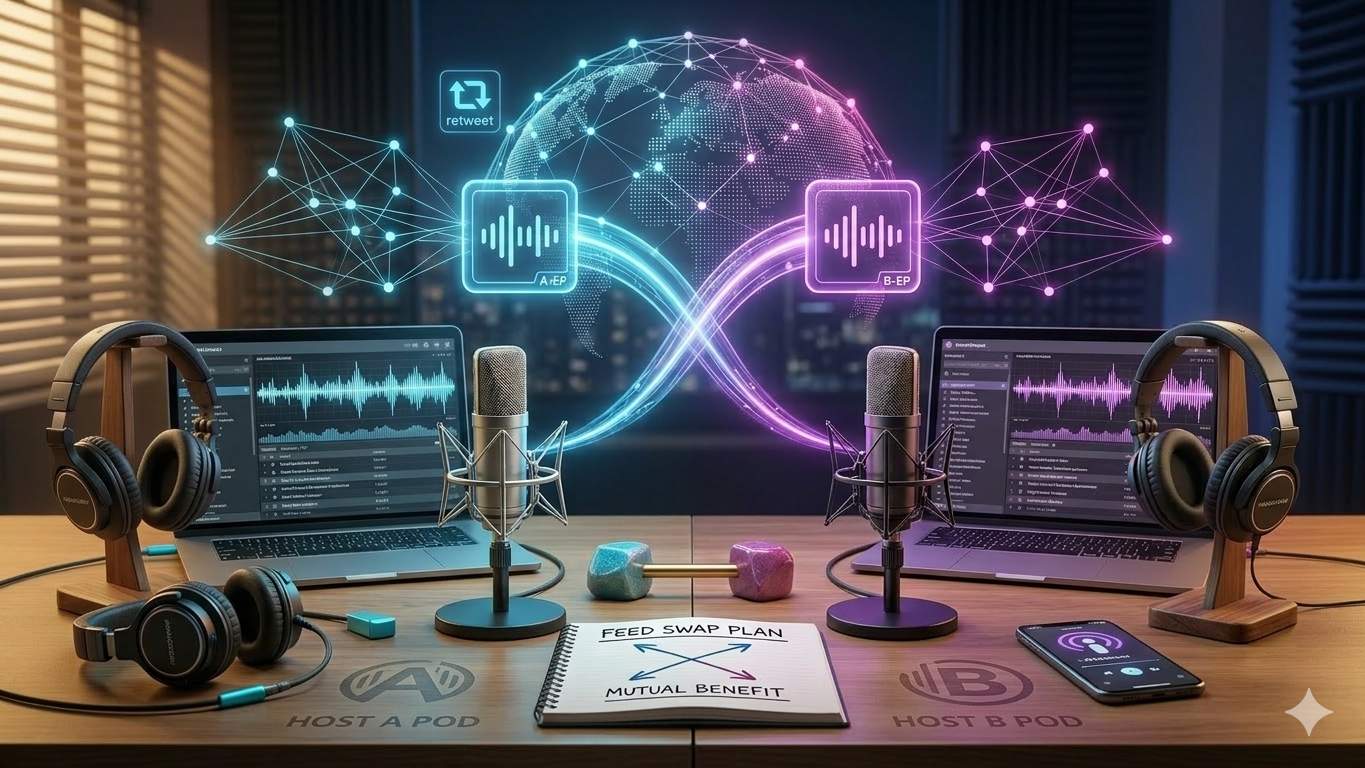
A feed swap gives you direct access to another show’s subscribers. It’s a warm introduction from a trusted source, which is far more powerful than any ad you could run.
Look for shows that share your ideal listener but aren't direct competitors. For instance, a podcast on "SEO for Startups" could easily swap feeds with one on "Content Marketing for Founders." The audience overlap is obvious, and the benefit is mutual.
Turn One Episode into a Dozen Marketing Assets
Strategic content repurposing is your secret weapon for getting the most out of every single episode without burning out. This is where having a video podcast pays off massively. Think of every long-form episode as the raw material for an entire marketing campaign.
From just one 45-minute video podcast, you can spin off a whole suite of promotional content:
- YouTube Shorts & TikTok: Isolate 5-7 punchy, compelling moments (30-60 seconds each). These are your hooks to grab new listeners.
- LinkedIn & X (Twitter): Pull 2-3 key quotes or takeaways and turn them into text-based posts. Pair them with a sharp graphic or a short audiogram.
- Instagram: Create a carousel post that breaks down the episode's main points into a visually engaging, easy-to-digest format.
- Blog Post/Newsletter: Use the episode transcript to write a full article. This is a huge win for SEO, helping you capture search traffic and giving you a foundation for future income streams. You can learn more in our guide on how to monetize a podcast.
This system works because you're meeting potential listeners on the platforms they already use. Someone might not commit to a 45-minute episode from a new creator, but they’ll happily watch a 45-second clip on TikTok. That clip becomes their entry point, giving them a taste of your content that leads them back to your full show.
Frequently Asked Questions
Starting a podcast without an audience can feel like shouting into the void. You've got the passion, but the path forward is full of questions. Let's cut through the noise and get straight to the practical answers you need to build momentum from scratch.
How Long Does It Take to Get Listeners on a New Podcast?
Let's be real: building a podcast audience is a marathon, not a sprint. If you're publishing a new episode every single week, you can realistically expect to see meaningful, consistent traction after 6 to 12 months.
Consistency is everything. In the early days, stop obsessing over total downloads. The numbers that actually matter are your downloads per episode in the first seven days and your listener retention.
Your first goal isn't to hit 10,000 listeners. It's to create a show that 10 people absolutely love—so much that they can't help but tell their friends about it.
Don't let small numbers get you down. Podcast growth feels slow and linear at first, but it compounds. As your back catalog grows and word-of-mouth finally kicks in, things will accelerate. Just stick with it.
Should I Start with an Audio-Only or a Video Podcast?
If you're launching today, starting with a video podcast is a massive strategic advantage. It's not even a debate anymore.
With YouTube now the number one platform for podcast discovery, going audio-only is like intentionally blindfolding yourself to the biggest growth channel available.
A video podcast isn't just about putting your face on camera; it's a content-generation engine. It lets you create dozens of short-form clips for YouTube Shorts, TikTok, and Reels—all acting as powerful hooks to draw new listeners to your full-length episodes.
Yes, you should still push an audio-only version to all the traditional directories. But making video the starting point of your production process gives you an undeniable edge when you have zero audience.
How Do I Get Guests for My Podcast with No Audience?
When you have no download numbers to show, you have to sell the vision. Your outreach should never, ever mention your audience size. Instead, your entire pitch needs to be relentlessly focused on what’s in it for them.
Here’s how you frame your value proposition:
- Targeted Exposure: Highlight that your show covers a specific niche, meaning they'll get in front of a highly-relevant future audience.
- Professional Quality: Assure them they'll look and sound incredible by mentioning your commitment to high-quality audio and video.
- Promotional Assets: Offer to create shareable video clips and quote graphics for them. This gives them free marketing content.
Go after emerging experts, authors with new books, or other creators who are hungry for promotion. A personalized, well-researched invite that shows you actually respect their work will always outperform a generic template.
What Are the Most Important Metrics to Track at the Beginning?
Forget about vanity metrics like total lifetime downloads. They’re a distraction. To know if your show is actually resonating, you need to track engagement.
For any new show, these are the only three metrics that count:
- Downloads Per Episode (First 7 Days): This is your best pulse check on your core listener base. As your show grows, this number should be trending up.
- Audience Retention Rate: Platforms like Spotify will show you exactly when people drop off. If you can keep your retention rate above 60%, you have a strong signal that your content is genuinely compelling.
- Qualitative Feedback: In the beginning, a single email or positive review is worth more than a thousand downloads. It’s proof that you’re building a real community, not just a spreadsheet of stats.
Feeling overwhelmed by the idea of producing a professional video podcast? The team at micDrop has your back. We handle everything end-to-end—from guided remote recording and multi-cam editing to creating all the short-form promotional clips you need. Let us manage the production, so you can focus on creating an amazing show. Learn more about our services.


