Corporate Video Production Services: A Guide to Brand Growth
So, what exactly are corporate video production services? Think of them less as a vendor and more as a strategic partner dedicated to creating video that hits specific business goals, whether that's marketing, internal training, or anything in between. It’s the entire process of turning an idea into a polished, professional video asset built to engage audiences and drive growth.
Unpacking Corporate Video Production Services
Let's use an analogy. If you wanted to build a custom house, you wouldn't just grab a hammer and some nails and hope for the best. You’d hire an architect and a general contractor to manage everything from the initial blueprints to the final walkthrough.
Corporate video production services work the same way. They bring the expertise, high-end equipment, and project management needed to take your core message and transform it into a compelling visual story.
This is a world away from just owning a nice camera. It’s a full-service approach that covers every single detail, making sure the final video aligns perfectly with what your business needs to achieve. This end-to-end management is exactly why more companies are bringing in professional partners to handle their video strategy.

From Blueprint to Final Cut
To really get what these services include, it helps to see the journey in three core phases. Each stage is crucial for a smooth process and a great final product, saving you from costly mistakes and wasted time down the road.
- Pre-Production: The Blueprint
This is all about strategy. It's where we nail down the concept, write the script, create storyboards, scout locations, and handle casting. A rock-solid pre-production plan is the foundation for the whole project. Actionable Insight: Dedicate at least 40% of your project timeline to pre-production. A detailed plan here prevents costly reshoots and ensures the final video aligns with your goals. - Production: The Construction
This is the actual filming. Whether it's on-location at your office, in a studio, or captured remotely, this phase is all about getting the raw footage. A professional crew manages the lighting, sound, and camera work to make sure every shot is high-quality and looks fantastic. - Post-Production: The Interior Design
This is where the story comes to life. Editors assemble all the footage, color grade the visuals, mix the audio, and layer in motion graphics, music, and sound effects. This final polish is what turns raw clips into a cohesive, engaging video that's ready for an audience.
A professional service doesn’t just execute tasks; it guides your strategy. They act as a partner, translating your abstract business goals into a tangible video asset that delivers measurable results.
More Than Just a Video
Ultimately, investing in corporate video production is about creating strategic assets, not just "making content." The numbers back this up. According to 360iResearch, the global corporate video market is on track to grow from USD 7.73 billion in 2025 to USD 12.73 billion by 2032.
This massive growth, which you can read about in the full corporate video production services market research on 360iResearch.com, shows how businesses everywhere are using professional video for brand storytelling, employee training, and customer engagement. The trend highlights a simple truth: well-made video is a powerful tool for business, and working with experts is the smartest way to get it right.
The Types of Videos Your Business Needs in 2026
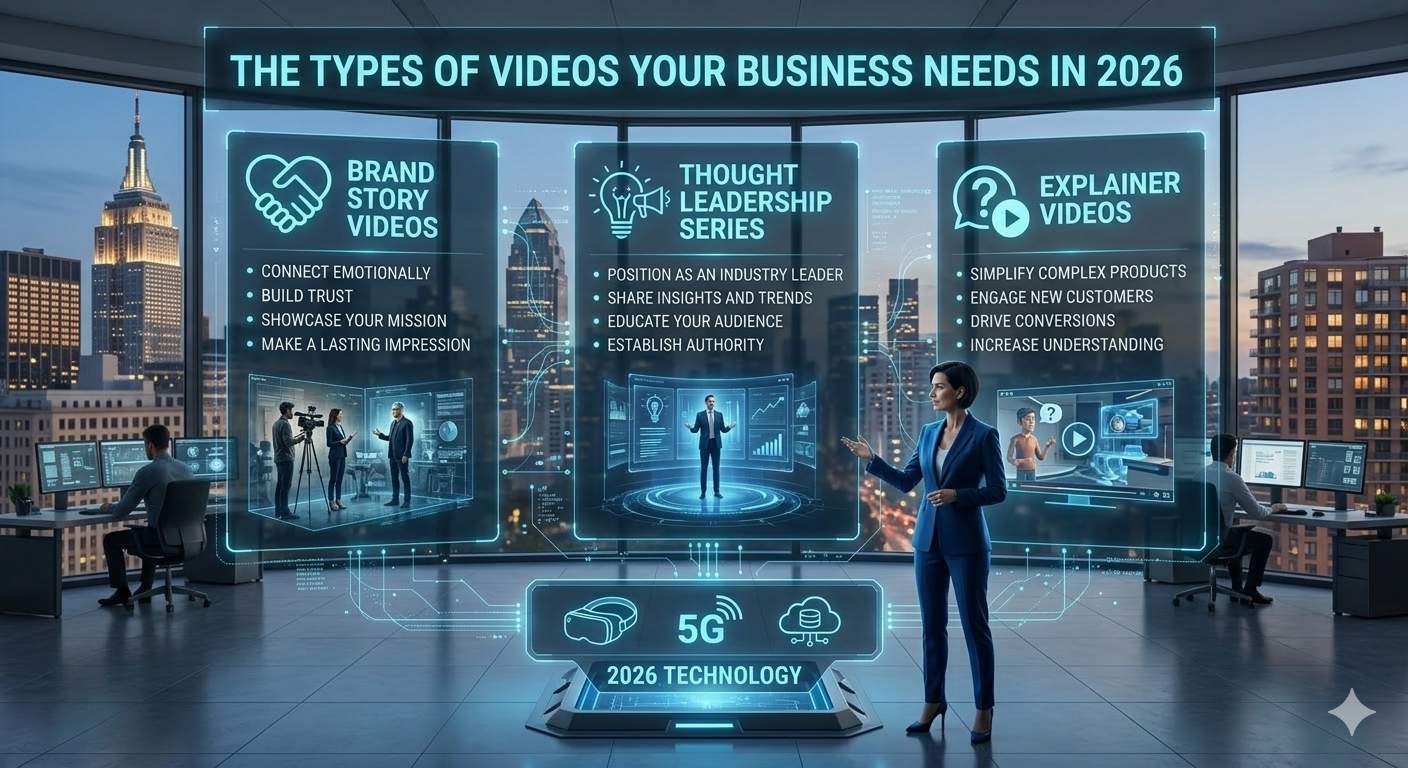
Knowing you need video is one thing. Knowing which videos to actually create is a whole different ballgame. Instead of just listing off video types, let's connect them directly to the business goals they help you crush. A smart approach to corporate video production services is all about choosing formats that fuel your marketing, sales, and HR efforts.
Think of your video strategy like a balanced investment portfolio. You wouldn't dump all your cash into a single stock, right? It’s the same with video. You need a mix of assets, each built for a specific purpose, audience, and stage of the customer journey.
Let's break down the essential videos by their strategic role. Consider this your playbook for building a content plan that truly delivers.
Videos for Marketing and Brand Building
Marketing videos are all about grabbing attention and building a genuine connection with your audience. They’re your first impression, designed to tell your story, build trust, and make people feel something about your brand.
- Brand Story Videos: This is your company's "why" distilled into a powerful 2-3 minute narrative. It’s not a sales pitch. It’s an authentic story that reveals your mission, your values, and the people behind the scenes. Actionable Insight: Feature real employees, not actors. Authenticity resonates more with today's audiences and builds a stronger emotional connection to your brand.
- Thought Leadership Series: These are recurring videos, usually featuring your company's experts or execs talking about industry trends and big ideas. Publishing them regularly on platforms like LinkedIn cements your brand as a trusted authority. It’s a fantastic way to build an audience and reel in B2B leads.
- Explainer Videos: These are short, punchy videos—animated or live-action—that quickly get to the heart of what your company, product, or service does. They’re perfect for landing pages and social media ads because they make complex ideas simple and drive real interest. For many businesses, a sharp explainer video is the secret to standing out.
A strong thought leadership video series does more than just share information; it builds a loyal following. By consistently offering valuable insights, you create a community around your brand, turning passive viewers into active advocates who trust your expertise.
Videos for Sales Enablement
Sales enablement videos are your secret weapons for helping the sales team close deals faster. They deliver critical info right when it's needed most, answering customer questions and building the confidence people need to pull the trigger.
These aren't about broad brand awareness. They’re all about targeted persuasion.
- Product Demonstration Videos: A solid product demo shows your solution in action, zeroing in on the features and benefits that solve a specific customer headache. Actionable Insight: Create multiple short demos, each focusing on a single feature or use case, to send to prospects based on their specific pain points.
- Customer Testimonial Videos: Nothing builds trust faster than social proof. Video testimonials feature happy customers sharing their real experiences, giving your claims authentic, relatable backup. Sprinkle these across your website, sales decks, and social media.
- Case Study Videos: A case study video goes a step beyond a testimonial. It tells the full story of how you helped a specific client tackle a challenge and get measurable results. This format is perfect for convincing those bottom-of-the-funnel leads who need to see hard proof.
Videos for HR and Internal Communications
Your video strategy shouldn’t end with customers. Professional video is also a massive asset for attracting top talent and keeping your own team aligned, engaged, and in the loop.
- "Day-in-the-Life" Recruitment Videos: Ditch the stiff corporate interviews. Authentic videos showing a typical day at your company give potential hires a real feel for your culture. Featuring current employees sharing their experiences makes your company far more relatable and attractive to the best people out there.
- Employee Onboarding and Training Videos: Onboarding videos ensure every new hire gets consistent, high-quality information from day one. Research shows video is a highly engaging and cost-effective way to handle training, which boosts employee skills and retention. These videos can cover everything from company policies to software tutorials. You can find more ideas on how podcasts are effective for business growth, which shares similar principles.
Comparing Video Production Models In-House vs. Agency vs. Remote Studio
So, how are you actually going to make all these videos? It's a huge decision, one that impacts your budget, your speed, and your long-term content strategy. Do you hire your own team, bring in a big-name agency, or try one of the newer remote studio models?
Each path comes with its own set of pros and cons. Let's walk through the three main ways companies are tackling video production today so you can figure out what makes sense for your business.
The In-House Team
This is the classic approach: you hire your own full-time videographers, editors, and producers. They become part of your company, living and breathing your brand every single day.
The biggest win here is control and speed. Your team is right down the hall, ready to jump on new ideas. They get your company culture on a deep level and can prioritize projects without getting in line behind another client.
But that control doesn't come cheap. The overhead is a killer—salaries, benefits, thousands in gear (cameras, lights, mics), software licenses, and the space to put it all. This only really works for massive companies with a constant, high-volume firehose of video content. For everyone else, the cost and management headache are just too much.
The Traditional Agency
Hiring a traditional production agency gets you a team of seasoned pros without the full-time payroll commitment. These folks bring serious creative chops, high-end gear, and experience from working across countless industries.
An agency handles everything from the initial creative concept to the final polished video. The downside? Agencies are often expensive and slow. Their process is built around big projects, involving detailed proposals, layers of meetings, and large crews. That’s great for a one-off Super Bowl ad or a flagship brand film, but it’s a bottleneck for businesses that need a steady drumbeat of content.
The Productized Remote Studio
This is the new kid on the block, a hybrid model that's gaining a lot of traction. A productized remote studio like micDrop offers the dedicated support of an agency but with the efficiency of a streamlined service.
You typically get an end-to-end production workflow, often for a predictable monthly fee. It's built specifically for creating high-quality, scalable content like B2B thought leadership series and video podcasts without the logistical headaches.
Below is an example of a productized remote studio's website, which emphasizes a streamlined and all-inclusive service.
The whole point is to remove the friction. You get a dedicated producer, guided remote recording sessions, and all the post-production handled for you. It's incredibly efficient and cost-effective, but you do trade the on-site, hands-on control you'd get with an in-house crew or a big agency shoot.
The numbers show a clear shift in how businesses are operating. According to SellersCommerce, 73% of companies produce videos with in-house teams or freelancers, while just 16% stick to outsourcing with traditional agencies. This has paved the way for a hybrid era where remote studios are thriving, especially as 31% of companies now mix in-house and external partners to get the best ROI. You can dig into more of these trends in the latest video marketing statistics from SellersCommerce.com.
The right video production model acts as a business accelerant, not a bottleneck. The goal is to find a partner that matches your need for speed, budget predictability, and content scalability, allowing you to focus on your message, not the mechanics.
To help you weigh the options, we’ve put together a simple comparison table. This breaks down what matters most—cost, speed, and quality—for each model.
Comparing Video Production Models In-House vs Agency vs Remote Studio
This table breaks down the key differences between building an in-house video team, hiring a traditional production agency, and partnering with a productized remote studio like micDrop across critical business factors.
Ultimately, there's no single "best" choice—only the best choice for your company's goals, budget, and desired pace. Use this breakdown to have an honest conversation with your team about what you truly need from a video production partner.
Breaking Down The Corporate Video Production Workflow
Thinking about professional corporate video production services can feel overwhelming, like you’re trying to understand a machine with a million moving parts. But a good process isn't complicated—it’s a clear, predictable assembly line.
Let's break down the journey from a simple idea to a finished video. It really comes down to three distinct phases. Think of it like an orchestra: Pre-Production, Production, and Post-Production. Each section has its part to play, but they all work together to create something great. A solid workflow is the secret to keeping your project on budget and hitting your goals without a hitch.
This flowchart can help you figure out the best production path based on your budget.
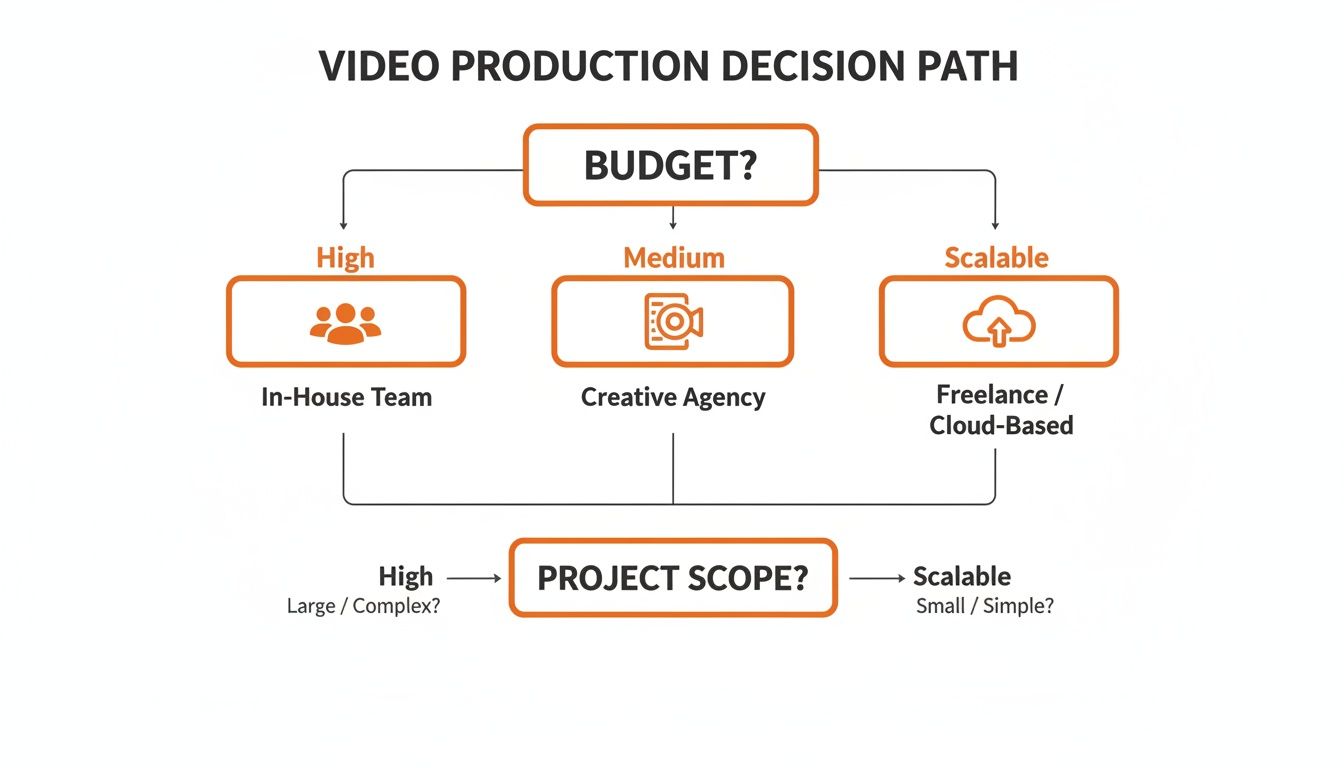
The main takeaway here is that the "right" way to produce your video really depends on your budget and how much you need to scale.
Phase 1: Pre-Production – The Blueprint
This is easily the most important phase. It's where all the strategy and planning happens, laying the foundation for everything else. Rushing pre-production is the #1 reason projects go over budget and fall flat. This is where you nail down the "what" and "why" before a single camera ever gets turned on.
Here’s what happens during pre-production:
- Strategy and Concept: Defining your video's main goal, who it's for, and the core message you need to deliver.
- Scriptwriting: Writing a script that tells a compelling story and gets your message across clearly.
- Storyboarding and Shot Listing: Creating a visual plan for the video, mapping out every scene and camera angle.
- Logistics and Scheduling: Finding talent, scouting locations, and getting all the people and gear lined up.
Think of pre-production as the architect's blueprint for a skyscraper. If you don't have a detailed, thoughtful plan, the final building is bound to have problems. A little extra time here makes the whole process smoother.
Phase 2: Production – Getting The Shots
This is the "lights, camera, action!" part of the job where the actual filming happens. Everything that happens on set is guided by the plan you made in pre-production. When you have a solid script and storyboard, the crew knows exactly what they need to capture.
Production usually happens in one of two ways:
- Traditional On-Site Filming: A crew shows up at your office or a studio with all the pro cameras, lights, and sound gear. This gives you the most control for a polished, cinematic look.
- Guided Remote Recording: Your team members are recorded from wherever they are, with a producer guiding them to make sure the footage looks and sounds great. It's a super-efficient and scalable way to create content like thought leadership videos or podcasts. For this to work, great audio is non-negotiable, which is why a proper audio interface setup for professional recording is so important.
Phase 3: Post-Production – Making The Magic Happen
Post-production is where the story truly comes to life. Editors, sound designers, and motion graphics artists take all the raw footage and sound bites and assemble them into a cohesive, engaging video. This final polish is what turns a folder of clips into a powerful asset.
This is where editors cut the footage, color grade it to look professional, and mix the audio for perfect clarity. They’ll also add in music, sound effects, and graphics like lower-thirds titles.
This is also where new trends are making a huge impact. According to Visla.us, emerging 2026 video trends on Visla.us show a massive shift toward creator-style authenticity. Corporate videos are starting to look less like slick commercials and more like raw, real videos from employees—the kind that builds trust on LinkedIn, YouTube, and even TikTok. With 69% of video marketers now focusing on social media videos (Source: Visla), this authentic style is proving to be a game-changer.
Understanding Video Production Costs and Measuring ROI
Let's get straight to it. When you're talking about professional corporate video production services, two questions always come up: "How much is this going to cost?" and "What’s the actual return?" These aren't just minor details; they're the make-or-break questions for any business investment.
So, let's unpack the pricing and, more importantly, how to know if your video is actually delivering value.
Common Pricing Models
First, you need to understand how agencies and studios charge for their work. The right model for you depends entirely on whether you need a one-off video or a steady stream of content.
- Per-Project Fee: This is the simplest model. You get a single, fixed price for a clearly defined project, like a brand anthem or a new product demo. It’s perfect when your needs are specific and you have a clear scope.
- Retainer Model: Need video content consistently? A monthly retainer is the way to go. You pay a set fee each month for a pre-agreed amount of work, like producing a weekly thought leadership series. This approach builds a much stronger partnership and almost always delivers more bang for your buck over time.
What Drives Production Costs
Several key factors will move the needle on your final quote. Knowing what they are helps you understand where your money is going and how to manage the budget without gutting the quality.
It’s a bit like building a car. A basic model gets you there, but if you want a high-performance engine, custom paint, and a killer sound system, the price goes up.
The main cost drivers are:
- Crew and Equipment: A large crew with specialized gear (multiple cameras, drone operators, advanced lighting) is going to cost more than a small, agile team. Simple as that.
- Complexity: A straightforward talking-head interview is far less expensive than a video that needs complex motion graphics, 3D animation, or visual effects.
- Location and Logistics: Filming on-site, especially if it involves travel, permits, or studio rentals, adds up quickly. This is where remote recording can be a huge cost-saver.
The most expensive video is the one that doesn't work. Investing in a clear strategy and professional execution from the start is how you avoid wasting your budget on an asset that fails to hit its mark.
Measuring the True ROI of Your Video Content
Once the video is live, the real work starts: measuring its impact. It’s easy to get distracted by vanity metrics like view count, but the true ROI is much deeper than that. The goal is to connect your video directly to business results.
You have to look past the surface-level numbers and find the data that proves your video is actually engaging people and influencing their decisions.
Key ROI Metrics to Track:
- Audience Retention: This is your holy grail. It shows you exactly where viewers lose interest and drop off. High retention means your message is hitting home and holding attention—the clearest sign of a quality video.
- Engagement Rate: Don't just count views; look at likes, comments, and shares. This tells you if the video is actually starting conversations and if people find it valuable enough to pass along.
- Lead Generation: Actionable Insight: Use tracked links (UTM parameters) in your video descriptions and calls-to-action to precisely measure which videos are generating leads and attribute them correctly in your analytics platform.
- Sales Cycle Impact: Talk to your sales team. Does sending a product demo or case study video help them shorten the sales cycle or close deals? This qualitative feedback is just as valuable as any dashboard metric.
How to Choose the Right Video Production Partner
Picking a partner for your corporate video production services is probably the single most important decision you'll make. It’s the difference between a video that just gets made and a video that gets results.
A great partner doesn't just hit the record button. They become a strategic extension of your team, guiding you from that first spark of an idea all the way to getting it in front of the right eyeballs. So, with a sea of options out there, how do you find the one?
Think of it like hiring a key employee. You wouldn’t just glance at a resume. You'd want to understand their experience, how they communicate, and if they'll click with your company culture. The same logic absolutely applies here. The goal is to find a team that has the technical chops and genuinely gets what you're trying to achieve as a business.
Evaluate Their Portfolio and Expertise
First things first: dig into their past work. Don't get distracted by flashy visuals alone. You need to analyze their portfolio for style, storytelling skill, and—most importantly—relevance to your industry.
For instance, in a place like the DC area, video is often used to signal institutional credibility. A partner's work needs to reflect that high level of professionalism if that's your world.
Look for a partner whose work just feels like your brand. If you’re a B2B tech company, a portfolio packed with slick lifestyle ads for consumer brands might be a red flag. You need a team that knows how to make complex ideas clear and compelling.
A partner’s portfolio isn't just a highlight reel; it's a window into their strategic thinking. Look for videos that successfully achieved a specific business goal, whether it was increasing donor support for a nonprofit or winning high-value clients for a business.
Ask the Right Questions
Once you have a shortlist, it's time for some real talk. The questions you ask will reveal everything about their process, their expertise, and what "success" actually means to them. Moving beyond "how much does it cost?" is how you find a real partner.
Here are a few essential questions to get the conversation started:
- What does your revision and feedback process look like? A messy, unclear feedback loop is a recipe for delays and frustration. You need a structured process.
- How do you measure the success of the videos you produce? A great partner is obsessed with ROI and business metrics, not just vanity numbers like views.
- Can you describe your ideal client or project? Their answer tells you if your project is in their wheelhouse or if they're just trying to land any client.
- Who will be my main point of contact? Knowing their team structure and how communication flows is vital for a smooth working relationship.
Focusing on these areas will help you confidently pick a production partner who will not only deliver incredible video but also help you hit your strategic goals.
And for anyone who really wants to get into the technical weeds of audio quality, you might want to check out our guide on understanding the audio frequency spectrum and EQ charts.
Frequently Asked Questions About Corporate Video Production
Getting into corporate video production brings up a lot of questions. If you’re trying to understand the costs, the process, or even just where to begin, you need clear answers. We’ve put together this FAQ to tackle the most common questions and help you move forward with confidence.
How Long Does It Take to Produce a Corporate Video?
The timeline for a video can be anything from a few days to several months. It all depends on the complexity.
A simple, remote-recorded thought leadership video might be finished in a week. On the other hand, a big brand story with shoots in multiple locations and custom animation could easily take 8-12 weeks from start to finish.
The biggest variable is always pre-production. A project with a locked-in script, a clear strategy, and all the logistics sorted out upfront will move much, much faster.
What Is a Realistic Budget for a Professional Video?
Just like timelines, budgets are all over the map. A basic remote video series could start in the low thousands per month. A high-end brand film with a large crew, actors, and slick graphics? That can run anywhere from $25,000 to $75,000 or more.
What drives the cost up?
- Crew Size: More people on set means a higher day rate.
- Equipment: Specialized gear like cinema cameras or drones adds to the price tag.
- Locations: Renting studios or moving the crew to multiple spots increases costs.
- Graphics and Animation: Complex motion graphics or 3D animation require specialized talent and time.
The goal is to find a partner who can tie your budget directly to your business goals. A great producer won't just spend your money—they'll help you invest it where it will make the biggest impact.
Do I Need to Write the Script Myself?
Nope, not at all. You bring the core message and the industry expertise; a full-service production partner handles the script. Their job is to translate your key points into a story that actually works on camera.
It’s a team effort. The process usually starts with a discovery call, followed by a script draft from the production team, and then a round of your feedback to get it just right. You’re the subject matter expert, and they’re the storytelling experts.
Ready to stop worrying about production and start creating content that drives results? micDrop offers an end-to-end solution for B2B brands and leaders, managing everything from guided remote recording to final publishing. Let our dedicated producers turn your expertise into a polished, scalable video series.


